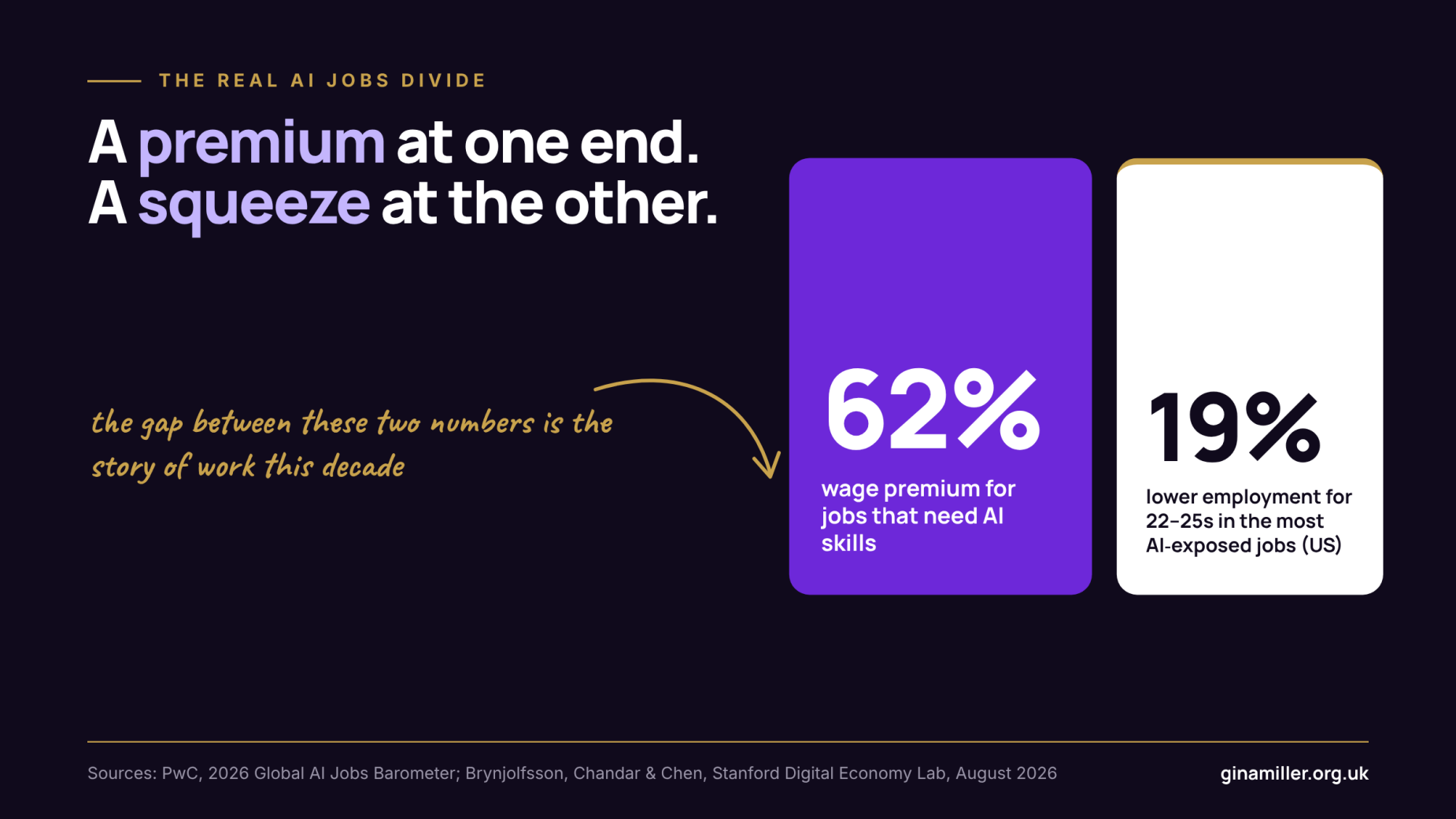
62%
Wage premium for jobs that need AI skills
Economy
October 2026 · 8 Min Read
Replaced or rewarded? The real AI jobs divide – and ways to close it
The popular claim says that by 2030 you will either be replaced by AI or paid handsomely to manage it. The evidence tells a more nuanced story. The divide is real, but it runs between people who get the chance to adapt and people who don’t. And that is something we can fix.
Two things can be true at the same time.
Workers whose jobs require AI skills are now paid, on average, 62% more than people in comparable roles without them – up from 57% a year earlier, according to PwC’s 2026 Global AI Jobs Barometer.
Meanwhile, employment among young people aged 22 to 25 in the occupations most exposed to AI is now around 19% lower than for people of the same age in less exposed jobs, according to Stanford University researchers tracking US payroll data – and that gap has widened from 15% a year earlier.
A premium at one end - a squeeze at the other. The gap between those two numbers tells the story of work as enter into the next decade, and it is why widely circulated claims deserve a careful look, against a backdrop of widespread worry, especially among young people.
"Replaced or highly paid": half right, and the wrong half is a dangerous one
The claim runs like this: by 2030 the job market will split in two. You will either be replaced by AI, or you will be highly paid to manage it. Is it that most people are studying for obsolete degrees, whilst a smart minority is quietly mastering the skills that matter.
The direction of travel is real. But the framing – a cliff edge, with machines on one side and a fortunate few on the other – is not what the most robust evidence shows. And believing it can push people towards the wrong decisions: panic, paralysis, or expensive courses promising easy riches.
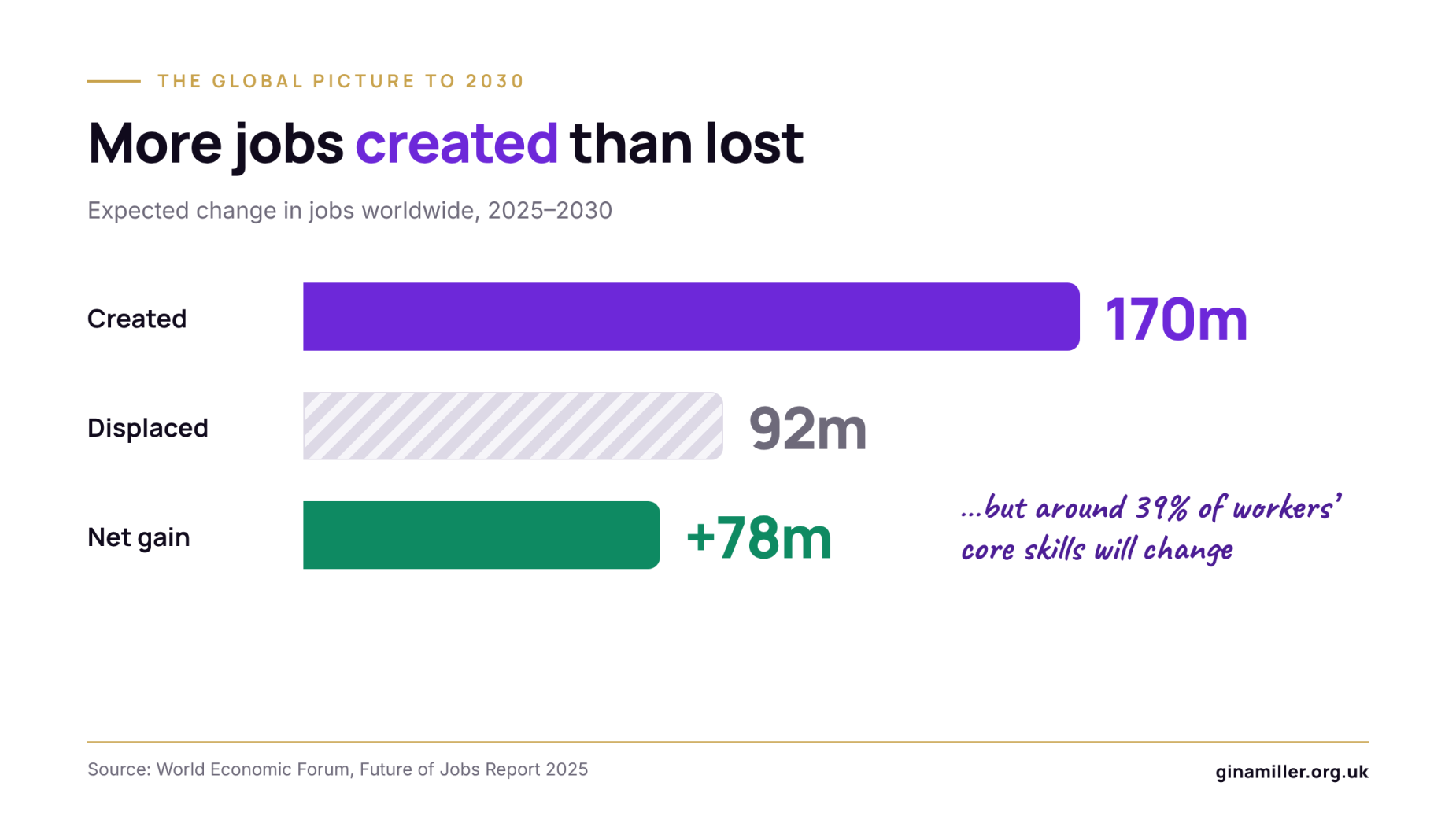
The World Economic Forum's Future of Jobs Report 2025 expects around 170 million new roles to be created worldwide by 2030 and around 92 million to be displaced – a net gain of roughly 78 million jobs.
The International Labour Organization estimates that one in four jobs worldwide is exposed to generative AI, and concludes that “transformation, not replacement, is the most likely outcome”.
The International Monetary Fund (IMF) estimates that around 40% of jobs worldwide will be affected, augmented, downgraded, or eliminated, and in October 2026 its Managing Director, Kristalina Georgieva, described AI as "a slow-moving tsunami" for jobs, growth, and education.
What changes most is not the number of jobs, but what is inside them. The same World Economic Forum (WEF) report expects around 39% of workers' core skills to change by 2030.
Put simply: if the world's workforce were 100 people, 59 would need retraining by the end of this decade – and 11 of them are unlikely to get it.
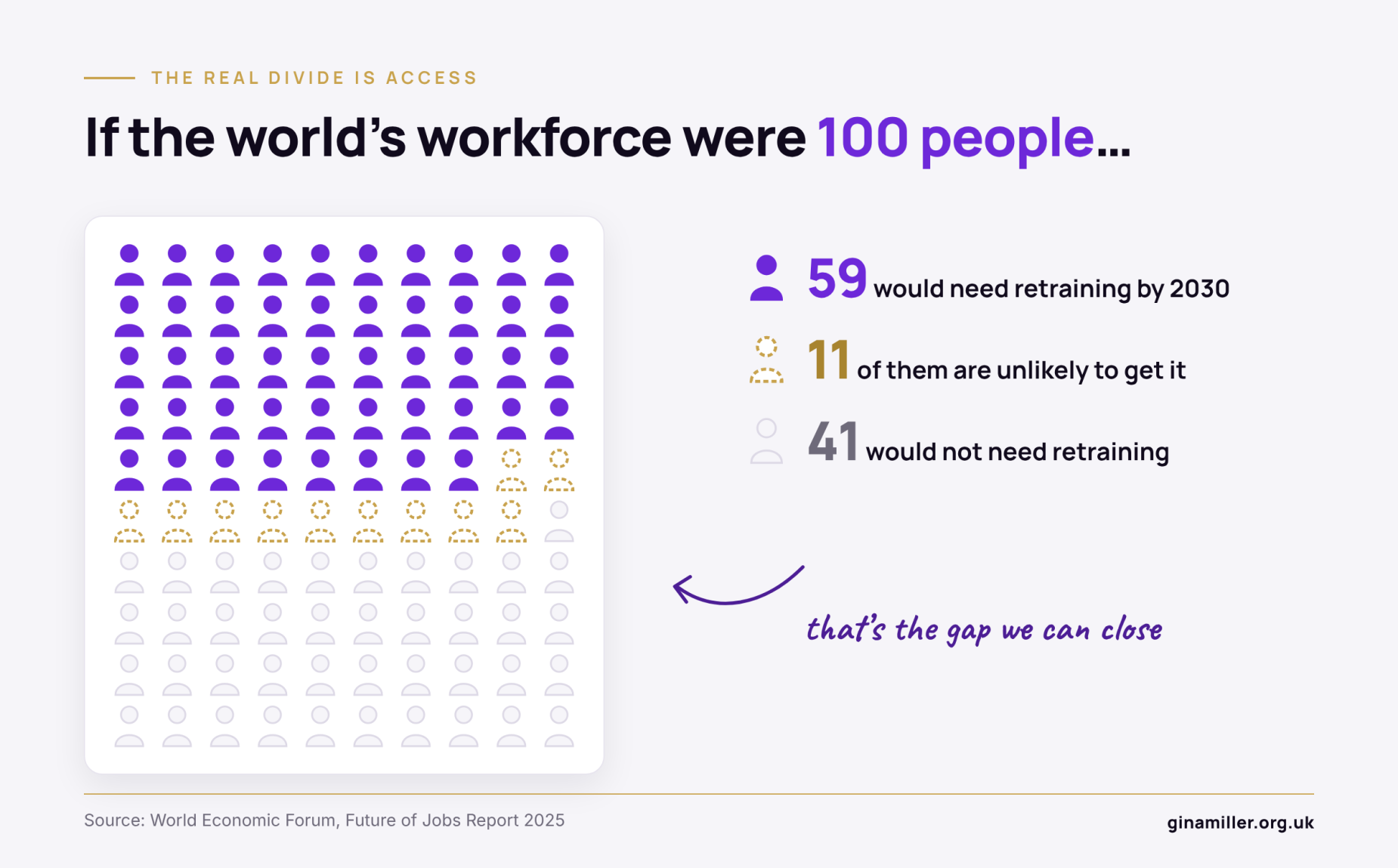
So, the real divide isn't humans versus machines. It is between those who are given the chance to adapt and those who aren't. That is a far more hopeful problem, because we can design access.
The real divide is not humans versus machines. It is between those given the chance to adapt and those who aren't.
The squeeze is on the first rung of the ladder
The group that needs to pay the most attention is young people at the start of their careers. The Stanford finding is striking precisely because experienced workers in the same occupations have held steady or grown. The losses are concentrated where AI automates tasks rather than assists the person doing them. Routine, well-defined work, the kind traditionally given to juniors so they could learn, is exactly what AI does well.
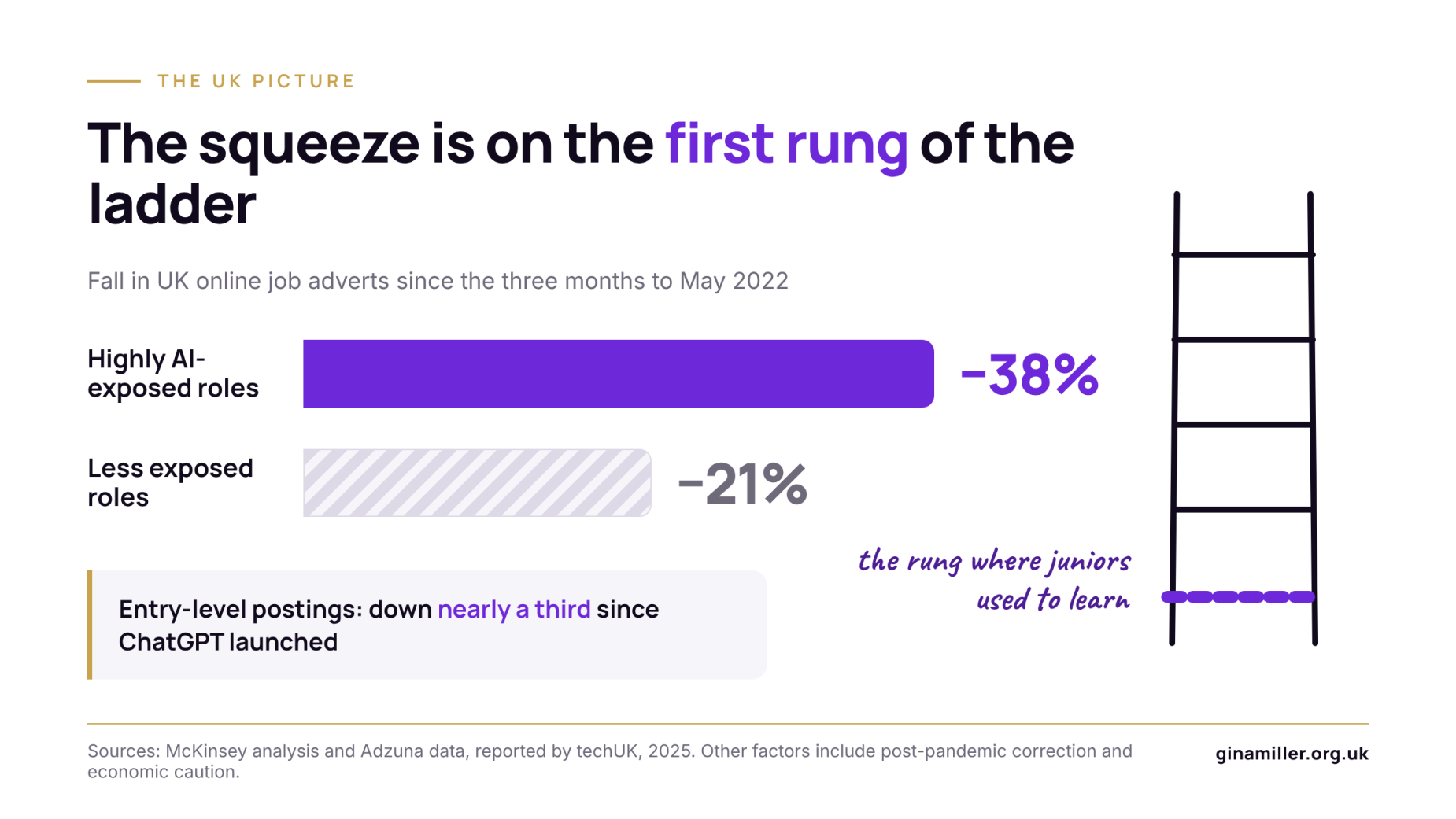
The UK picture echoes this. Adzuna data shows entry-level job postings have fallen by nearly a third since ChatGPT launched, and McKinsey analysis found online adverts for highly AI-exposed roles fell by 38%, against 21% for less exposed roles. AI is not the only cause; a post-pandemic correction, higher employment costs and economic worry and caution all play a part, but the pattern is consistent and warrants serious attention. This summer, the jobs site Adzuna recorded its lowest number of graduate vacancies since it began recording in 2016: 8,383 in July, down 46% from a year earlier. Labour market analysts caution that adverts capture only a slice of graduate hiring, and employers cite cost control ahead of AI as the main reason for hiring fewer graduates, but the trend is hard to ignore.
A question I am hearing increasingly is, does the changing job landscape make degrees obsolete? No! Analytical thinking, weighing evidence, and clear writing remain among the skills employers value most. But a degree is now a starting point, not a finished product.
A degree is now a starting point, not a finished product. What has become obsolete is the idea that learning stops at graduation.
Where the work, and the money, is moving
The lists of "high-leverage" roles doing the rounds online are long: automation architects, AI workflow directors, AI-first designers, micro-SaaS founders, one-person media houses, AI video producers, community founders, data translators, cybersecurity specialists, med-tech integrators and more. Strip away the hype, and they fall into five families. Each is real. Each also comes with something worth knowing before you invest your time.
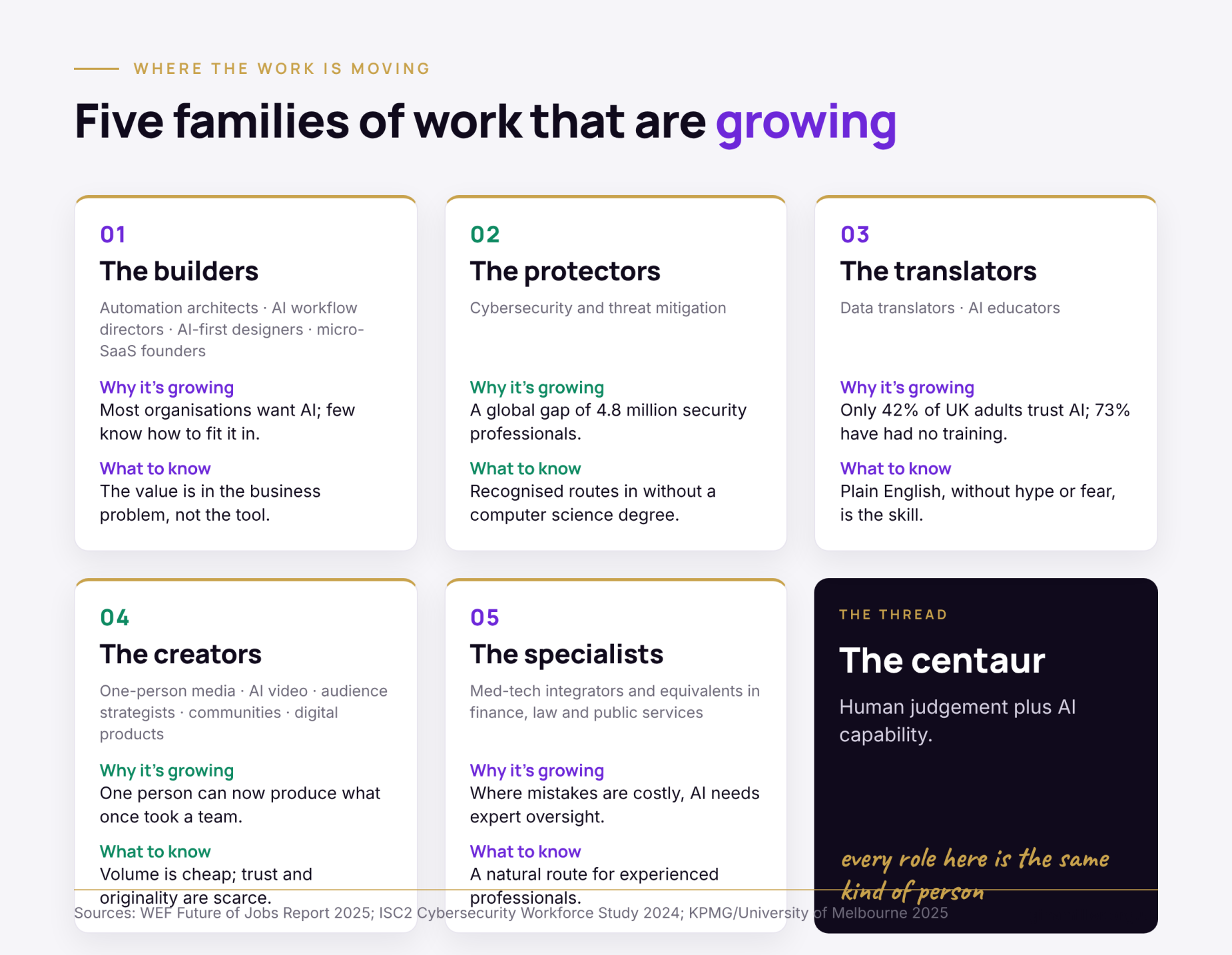
1. The builders: turning AI into systems that work
AI automation architects, AI workflow directors, AI-first UX designers, micro-SaaS founders.
Most organisations want AI; far fewer know how to fit it into the way they operate. People who can connect tools, data and processes – so that a task that took a team a week runs reliably overnight – are in demand. AI and machine-learning specialists, software developers and big-data specialists are among the WEF's fastest-growing roles.
What to know: the value lies in understanding the business problem, not the tool. Tools change every few months; knowing how a claims department, a supply chain or a hospital ward really works does not. And AI agents "working while you sleep" will still need someone awake to check their work.
2. The protectors: security in an age of automated attack
Cybersecurity and threat mitigation. As AI makes attacks faster and cheaper, defence becomes more valuable.
ISC2, the international non-profit body for cybersecurity professionals best known for the CISSP qualification, publishes an annual Cybersecurity Workforce Study. Its latest, published in December 2025, found that 95% of security teams have at least one skills gap – and that AI is now the skill they most need, cited by 41%, ahead of cloud security.
This is one of the clearest and most durable opportunities on the list, with recognised qualifications and routes in that do not require a computer science degree.
3. The translators: turning data and technology into understanding
Data translators and AI educators.
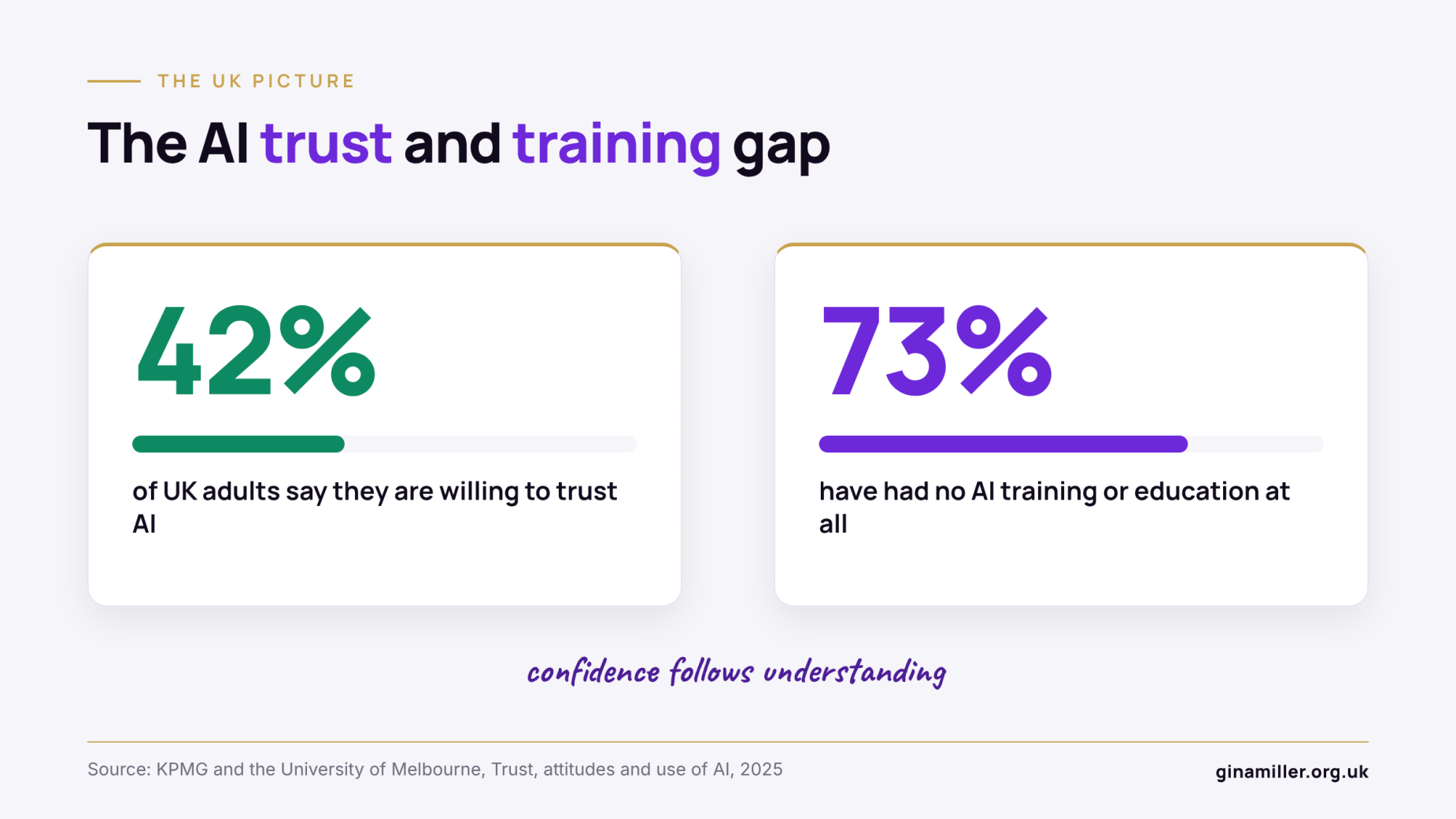
Organisations are awash with data but short of people who can turn it into sound decisions and explain them to a board. The public needs help too. In the UK, only 42% of people say they are willing to trust AI, and 73% have had no AI training or education at all (KPMG and the University of Melbourne, 2025). People who can explain complex technology in plain English – without hype and without fear – will be needed in every sector.
If an explanation makes you feel stupid, the problem is the explanation, not you.
4. The creators: media, communities and digital products
One-person media houses, AI video producers, brand and audience strategists, niche community founders, creators of templates and courses.
AI has collapsed the cost of making content: one person can now produce what once took a team. That is a welcome democratisation, and it opens doors for people who were never let into traditional media.
What to know: when anyone can produce more, volume stops being an advantage. Low-barrier markets crowd quickly, and rewards tend to concentrate among a few. What becomes scarce – and therefore valuable – is trust, originality, judgement and a genuine relationship with an audience. People entering this career path and building a business in this space also need to understand copyright and the disclosure of AI-generated content before they start.
5. The specialists in high-stakes sectors
Med-tech integrators and their equivalents in finance, law and public services.
Where mistakes are costly, AI needs people who understand the technology, the regulation, ethics, and human consequences. These roles reward deep sector knowledge combined with technical fluency – which makes them a natural route for experienced professionals, not only new graduates.
The thread that runs through all five
Every one of these roles describes the same kind of person: someone who combines human judgement with AI capability. In chess they call it the "centaur" – human and machine together outperforming either alone. As the economist Richard Baldwin, a professor of international economics at the Geneva Graduate Institute, said at the World Economic Forum's Growth Summit in Geneva in 2023: AI won't take your job; someone using AI will.
That is a warning, but it is also an invitation. PwC’s latest barometer found that jobs requiring AI skills are growing roughly eight times faster than the job market as a whole.
In the US, entry-level roles exposed to AI have grown 35% since 2019, while other entry-level roles have shrunk, and those roles increasingly ask for the human skills once expected only of senior staff. The good news is that the skills involved are learnable, and most of them aren't technical.
Who risks being left behind – and why it is not their fault
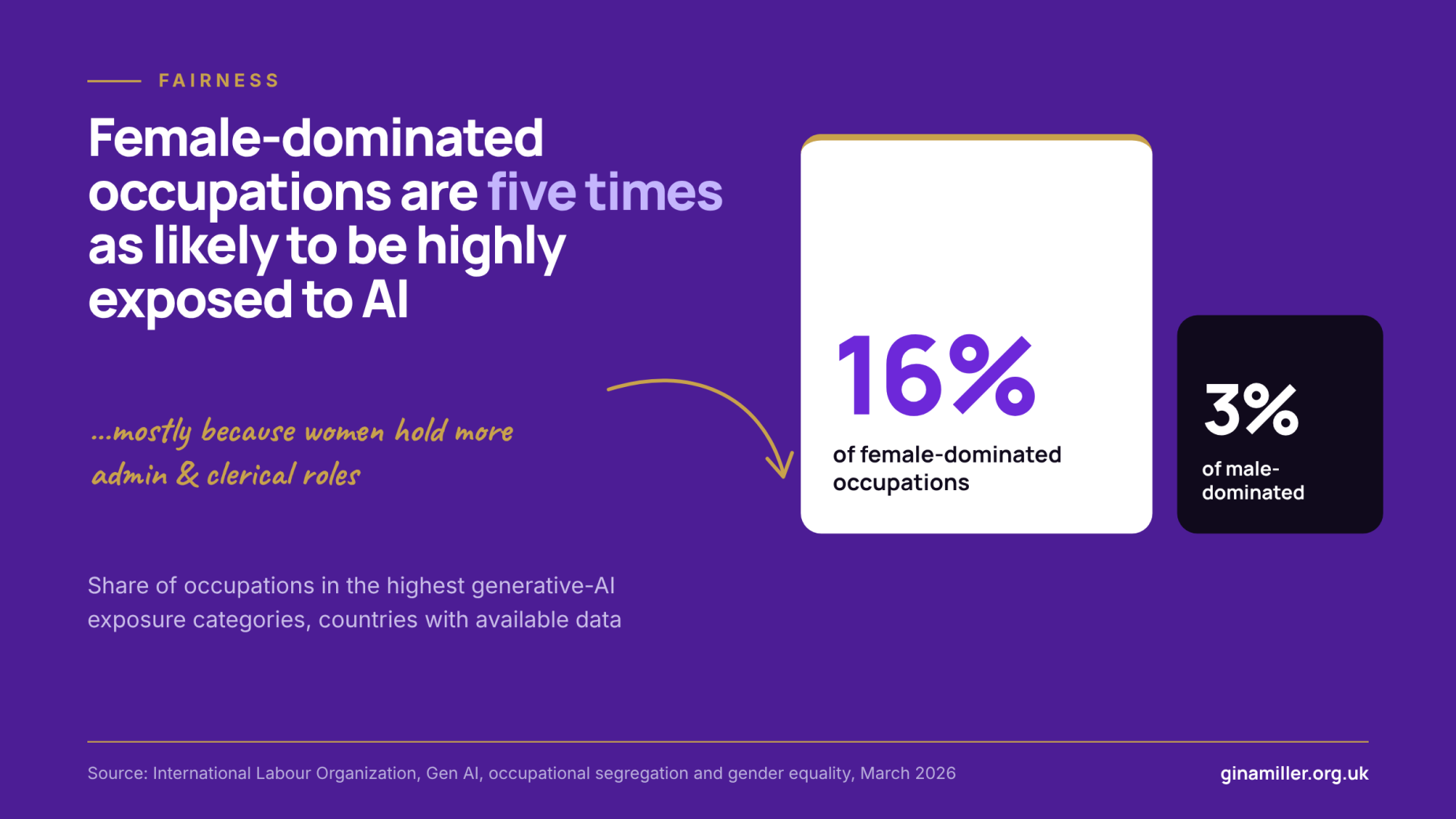
The tech and AI disruption happening will not fall evenly. In March 2026, the International Labour Organisation, the UN agency that deals with work and employment, found that 16% of female-dominated occupations fall into the highest-exposure categories, compared with 3% of male-dominated ones – largely because women are over-represented in administrative and clerical work. In the UK, more than 40% of women’s employment is exposed to generative AI.
Young people entering the workforce are also exposed, as we are seeing. Those who most need retraining are often least likely to be offered it – because of time, cost or caring responsibilities.
None of this is a failure of individuals. It is a design problem. And design problems have solutions.
Progressive pathways: what each of us can do
If you are working, or about to start
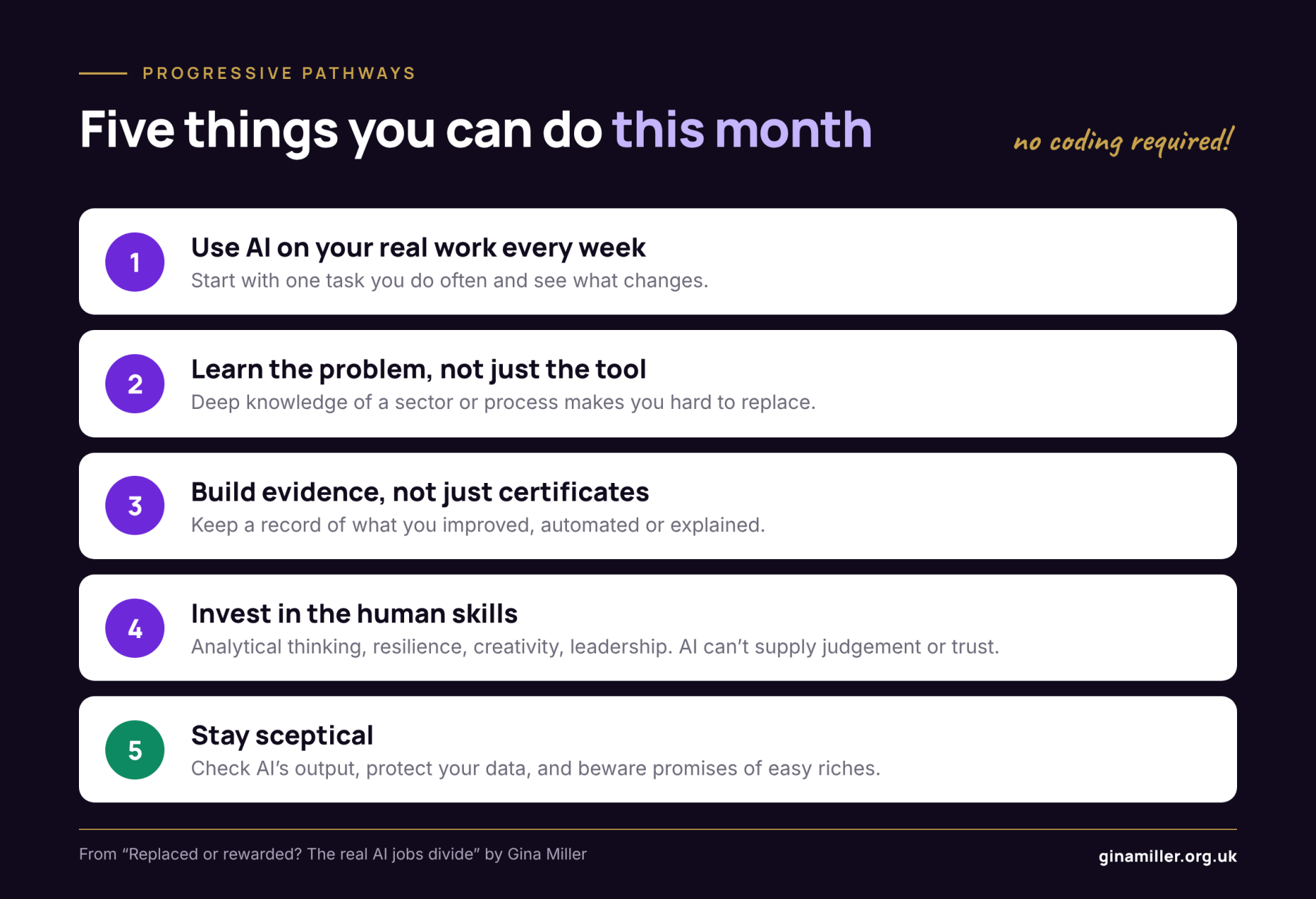
- Use AI on your real work every week. Practice beats theory. Start with one task you do often and see what changes.
- Learn the problem, not just the tool. Deep knowledge of a sector, process, or customer is what makes AI useful, and you hard to replace.
- Build evidence, not just certificates. Keep a short record of what you improved, automated or explained. Employers hire proof.
- Invest in the human skills. Analytical thinking, resilience, flexibility, creative thinking and leadership top the WEF’s list of core skills employers value. AI can't provide judgement, ethics or trust.
- Stay sceptical. Check all AI’s output, protect your data, and be wary of anyone promising easy riches from AI – including those selling courses that promise it.
If you employ people
- Protect the first rung. Redesign junior roles so AI handles routine tasks while new starters learn judgement – apprenticeships for the AI age. Cut the entry level today and you will have no experienced people tomorrow.
- Retrain before you reduce. The WEF finds 85% of employers plan to upskill their workforce, while 40% expect to reduce headcount where AI can automate. Make reskilling the first option, not the last.
- Be open with your people – employees, clients and stakeholders. Explain where AI is being used and how roles will change. Uncertainty damages morale and trust more than honesty.
If you teach or train
- Embed AI literacy across every subject, not only computing.
- Assess reasoning and judgement, not just outputs a machine can produce.
- Expand short, stackable and recognised credentials alongside degrees and apprenticeships, so people can update their skills throughout their working lives.
For policymakers, whoever is in office
- Measure what matters. The UK has expanded its pledge to train 10 million workers in AI skills by 2030. Publish progress, and track who is being reached – particularly young entrants, women in administrative roles, older workers and staff in small firms.
- Make lifelong learning portable. Training support that follows the individual, not the employer, helps people move between jobs and sectors as work changes.
- Watch the entry level. Treat graduate and school-leaver hiring as a priority, look for early-warning indicators, and act before a lost cohort becomes a lost generation of experience, hope and ambition.
The choice in front of us
The future of work is not something that simply happens to us. Evidence shows more jobs being created than lost, but a real risk is that the gains flow to those who already have access to learning, while the costs fall on the young, on women, and on those with the least time to retrain.
That outcome is not inevitable. It is a set of choices by individuals, employers, educators and governments.
History has shown us that out of crisis comes innovation, curiosity and creativity – that necessity really is the mother of invention.
The skills are learnable. The pathways can be built. What is needed now is not more prediction, but real action.