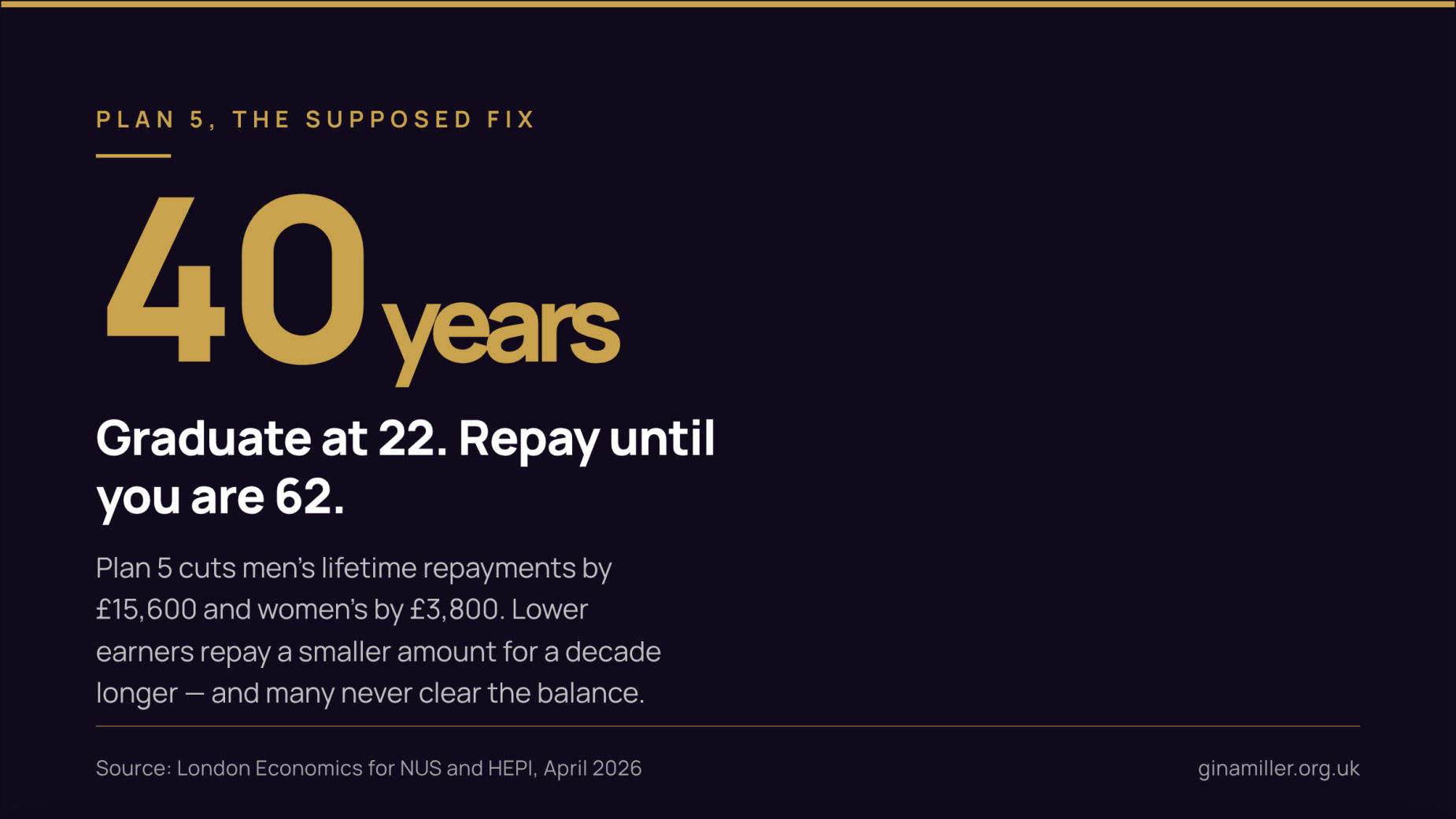
40 years
Graduate at 22. Repay until you are 62.
Fairness
November 2026 · 8 Min Read
They changed the student loan terms after students signed. And still haven’t fixed it.
A select committee found that student loans were mis-sold, but the government disagreed and did nothing in the Autumn to improve fairness and outcomes. And the one reform that could have paid for fixing it has already been spent on something else.
The essay
I have worked in regulated financial services for 30+ years, and there is a rule so basic that nobody argues about it – you cannot change the terms of an agreement after someone has signed it, to their disadvantage, without their consent.
If a bank did it, the Financial Conduct Authority would act. If we did it as investment managers, I would expect to lose our permissions. Yet government has done it repeatedly, to millions of graduates.
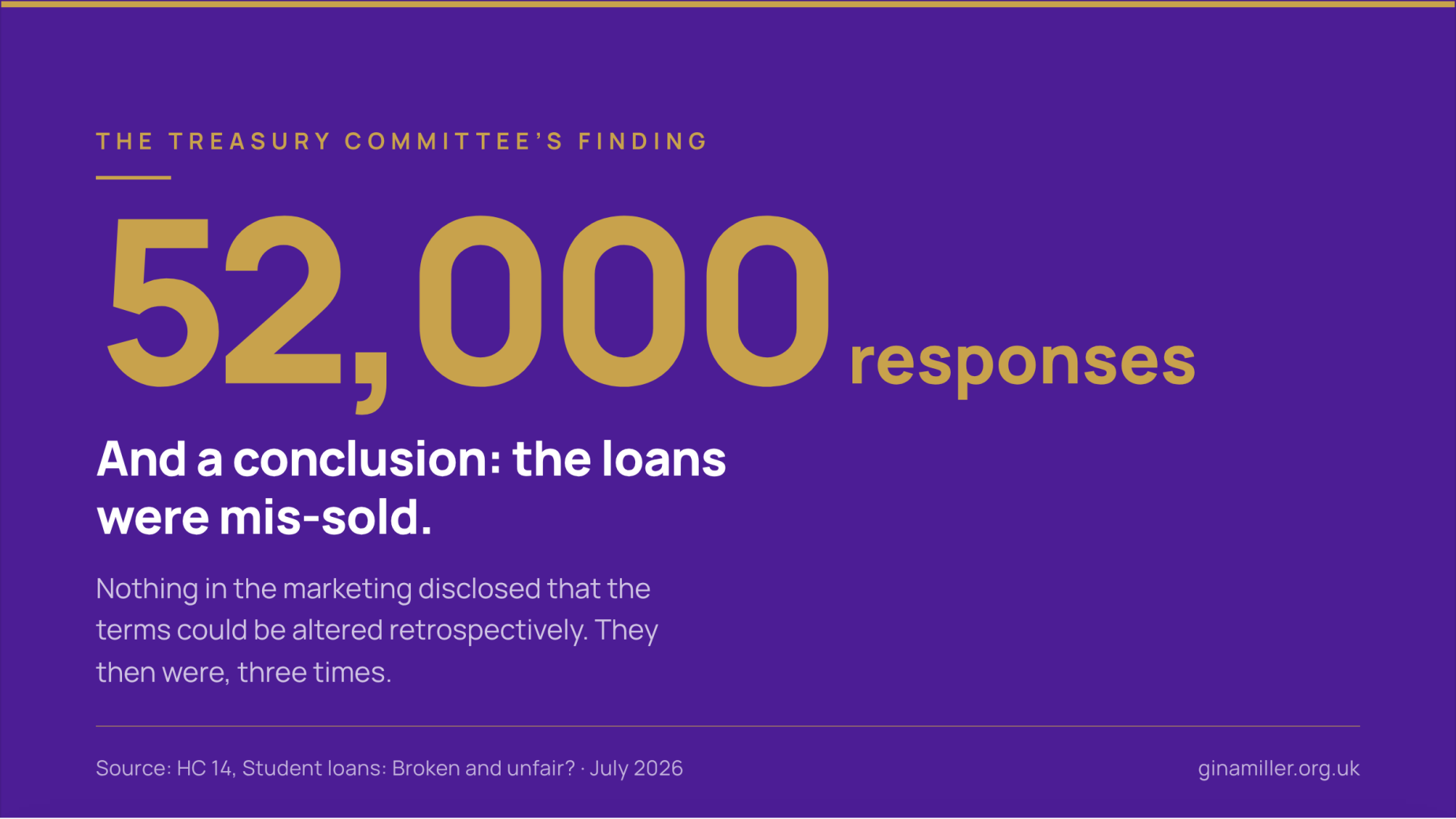
In July, the House of Commons Treasury Committee published a report on student loans. Its call for evidence drew more than 52,000 responses, which tells you something on its own. The title said the system was broken and unfair. The findings went further, with the Committee concluding that student loans had been mis-sold.
None of it had been disclosed - not in the marketing, not in the comparisons to a phone bill, not in the warnings meant to flag that terms could change. Nobody was told the terms could be altered retrospectively, and then they were.
The Committee said the government had a moral obligation to reverse the freeze on the repayment threshold at the Autumn Budget.
In September, the government declined. In October, the Budget came and went without mentioning student loans at all.
What was actually changed
Someone who started university in 2012 borrowed under Plan 2. The published terms were clear. Repay 9% of your income above a threshold. That threshold rises every year, and anything still outstanding is written off after 30 years.
The threshold was the protection. It was the thing that meant a modest earner would repay modestly.
That threshold has been frozen, over and over. It sat at £21,000 from 2012 to 2018, and is £29,385 today. And under the 2025 Budget it is frozen there for three more years from April 2027, holding until 2030.
But when prices are rising, freezing a threshold is a tax rise that nobody announces. Every year the protection is worth less, as more of your income falls above the line.
You pay more than the deal you signed for. Nothing was taken away, it simply stopped being given.
The English student loan book now stands at around £295 billion. It is forecast to peak at roughly £517 billion in today’s money by the mid-2040s, with about 39% of the value of Plan 2 loans is expected never to be repaid.
This is not a loan book in any sense a lender would recognise. It is a graduate tax dressed up as a debt. And it has the worst features of both: the weight of a balance hanging over you, and the open-ended liability of a levy.
Who the freeze actually hits
This is where the fairness question stops being abstract. The evidence published in April 2026 is genuinely striking.
London Economics modelled lifetime repayments for the 2022-23 cohort, for the National Union of Students and the Higher Education Policy Institute.
Under the original Plan 2 terms, men would have repaid an average of £55,100 over their lifetimes. Women would have repaid £26,300.
Under Plan 2 as it now stands, with the threshold freeze, men repay £68,500. Women repay £43,200.
Men’s lifetime repayments rose by around 24%, and women’s rose by around 64%.
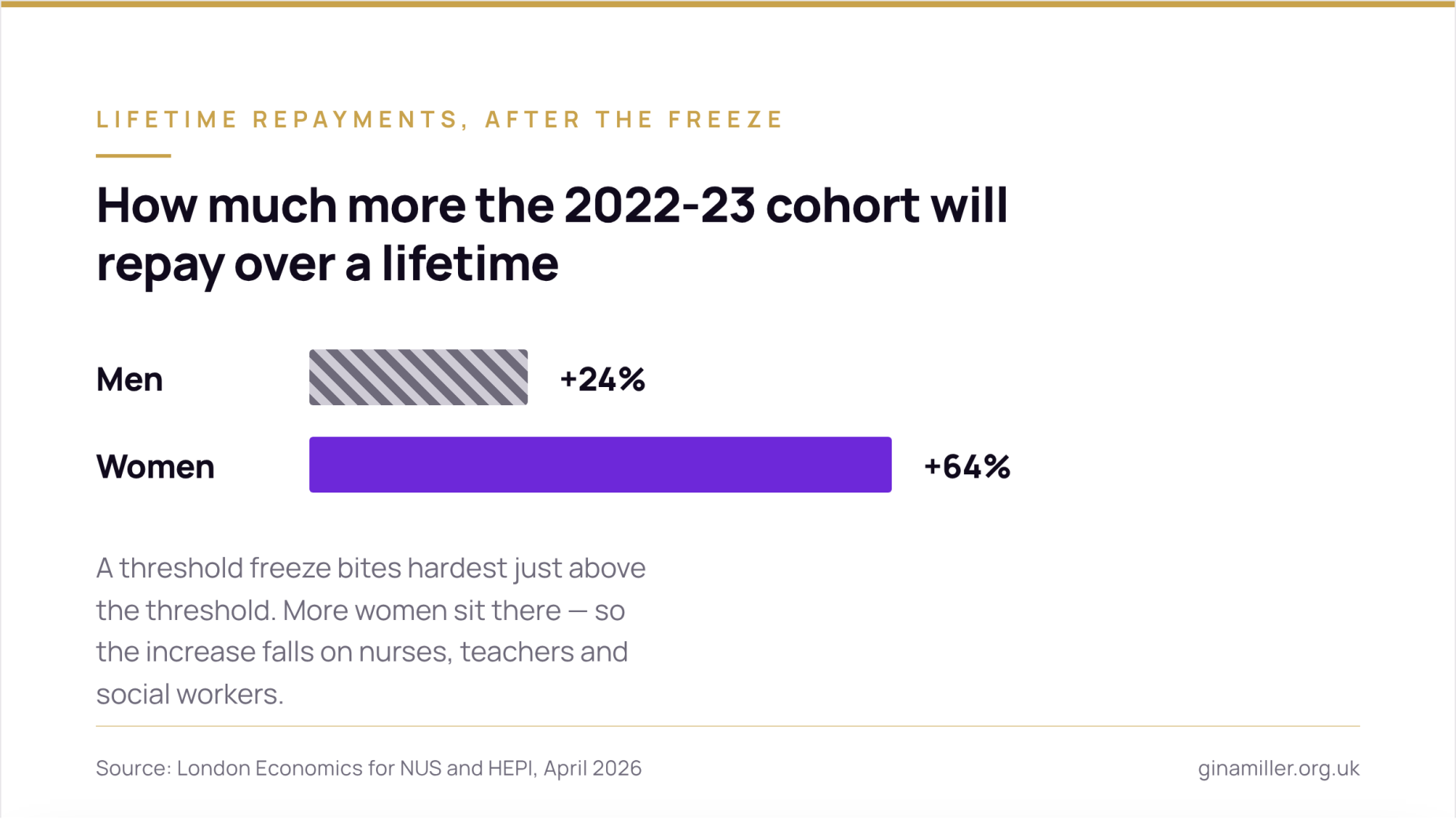
The reason is mechanical rather than sinister, and that is exactly the problem. A threshold freeze bites hardest on people earning just above the threshold. More women sit there so the increases fall on nurses, teachers and social workers. Graduates in law, technology and finance are mostly men, and they clear their balances anyway, so they are barely touched.
Nobody in government sat down and decided that nurses should pay more than solicitors. They adjusted a number. The number did the rest.
Plan 5, for students starting from 2023, is presented as the fix. On the same modelling, Plan 5 cuts men’s lifetime repayments by £15,600, and cuts women’s by £3,800.
And the write-off period now runs for 40 years instead of 30. So lower-earning graduates - mostly women - repay more under Plan 5, not less. They pay a smaller amount for a decade longer, and many will pay for almost their entire working lives and never clear the balance.
Forty years, for someone who graduates at 22, means repaying until they are 62.
The second bill, which arrives 30 years later
I have written separately about why the gender wealth gap is really a pension gap. Student loans are one of the places that gap starts.
Nine per cent of your income comes out in the decade when pension contributions compound hardest.
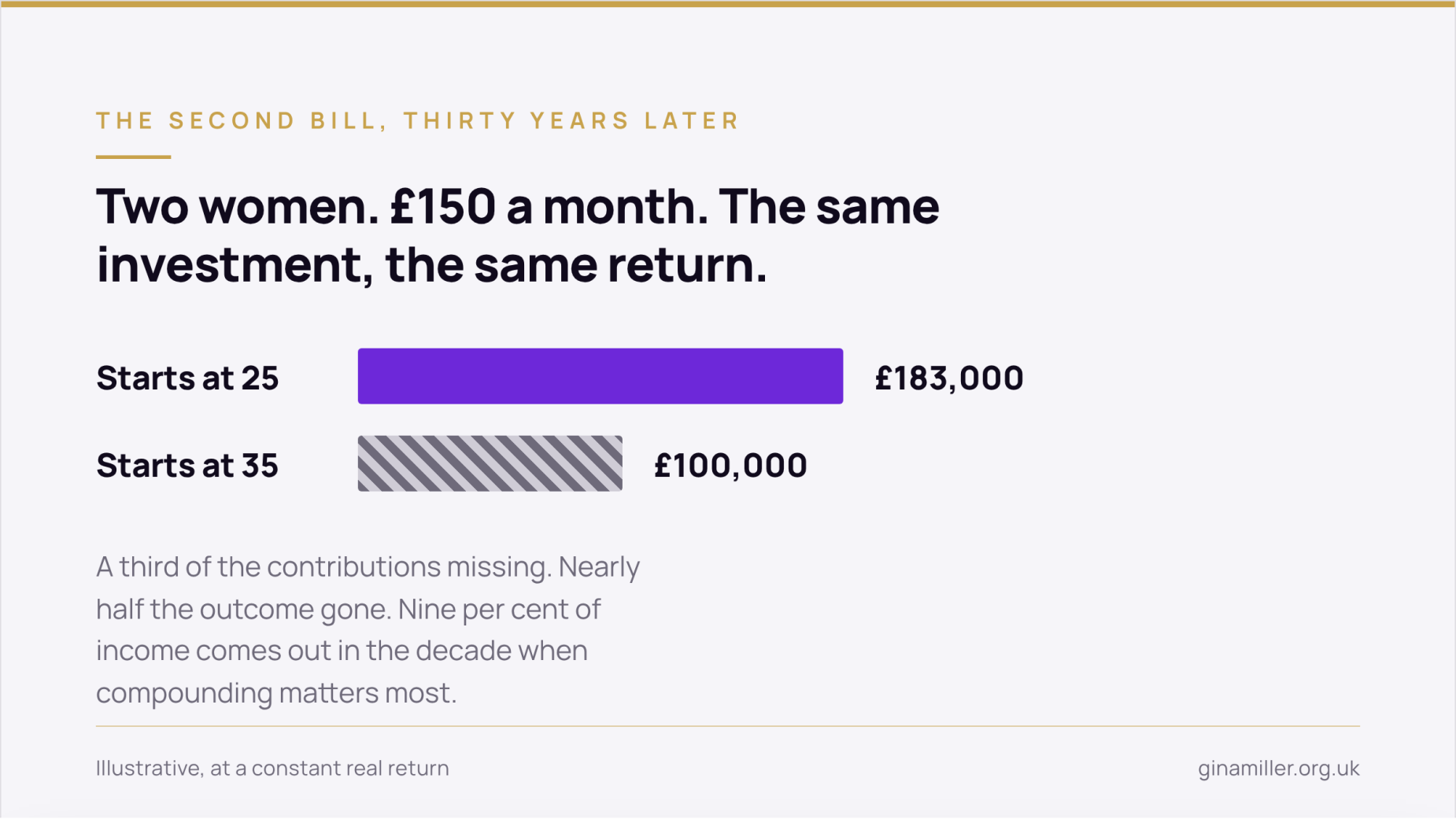
Take two women. Each puts £150 a month into the same investment, at the same real return.
The one who starts at 25 contributes £72,000 over her working life. She ends up with roughly £183,000.
The one who starts at 35 contributes £54,000. She ends up with roughly £100,000.
A third of the contributions missing, and nearly half the outcome gone.
Then add a career break. Repayments pause when income drops below the threshold, BUT interest does not. A woman who takes time out to care accrues interest throughout. She returns to a bigger balance, on a lower salary, and her pension contributions have stopped altogether.
The Institute for Fiscal Studies now publishes lifetime figures split by sex, and they show the picture. Women repay around £22,000 over a lifetime, compared with men’s £27,000. But women recoup only about 40% of what their degree cost up front, whilst men recoup 48%.
Female graduates borrow the same and get less back.
Women are 55% of full-time undergraduates and receive 57% of degrees awarded. Most people in this student loan system are women, and the system’s adjustments hit them hardest.
The trade-off that was made without them
Now, the part that prompted me to write this, and the part I find hardest to fathom.
When I published a white paper on this in March 2026, I argued that fixing student finance would have to be paid for. The most honest source available, I said, was the state pension triple lock. The Office for Budget Responsibility estimates it would cost around £15.5 billion a year more than earnings-linked uprating by the end of the decade - against roughly £5 billion when it was introduced. I said intergenerational fairness required that conversation to happen out loud.
In September, Prime Minister Burnham announced that the automatic earnings link will be removed from April 2030. The conversation happened. The reform happened with the government saying the savings - an estimated £15 billion a year by 2040 – would go towards a National Care Service.
I want to be careful here. The obvious thing to write would be that graduates were robbed, and I do not believe that. Social care in this country is in a desperate state. The people who depend on it are among the most vulnerable. Anyone arguing that student loan relief should have come first needs to make that case honestly, not by implication. I am not making it. A government that found £15 billion a year and put it into care has done something defensible.
My objection is to the process, not the destination.
The trade-off was framed as a choice between pensioners and care. Graduates were never a party to it. At no point were the three claims set side by side and weighed in public. And the group least likely to be in the room was the student group whose terms had already been altered three times without consent.
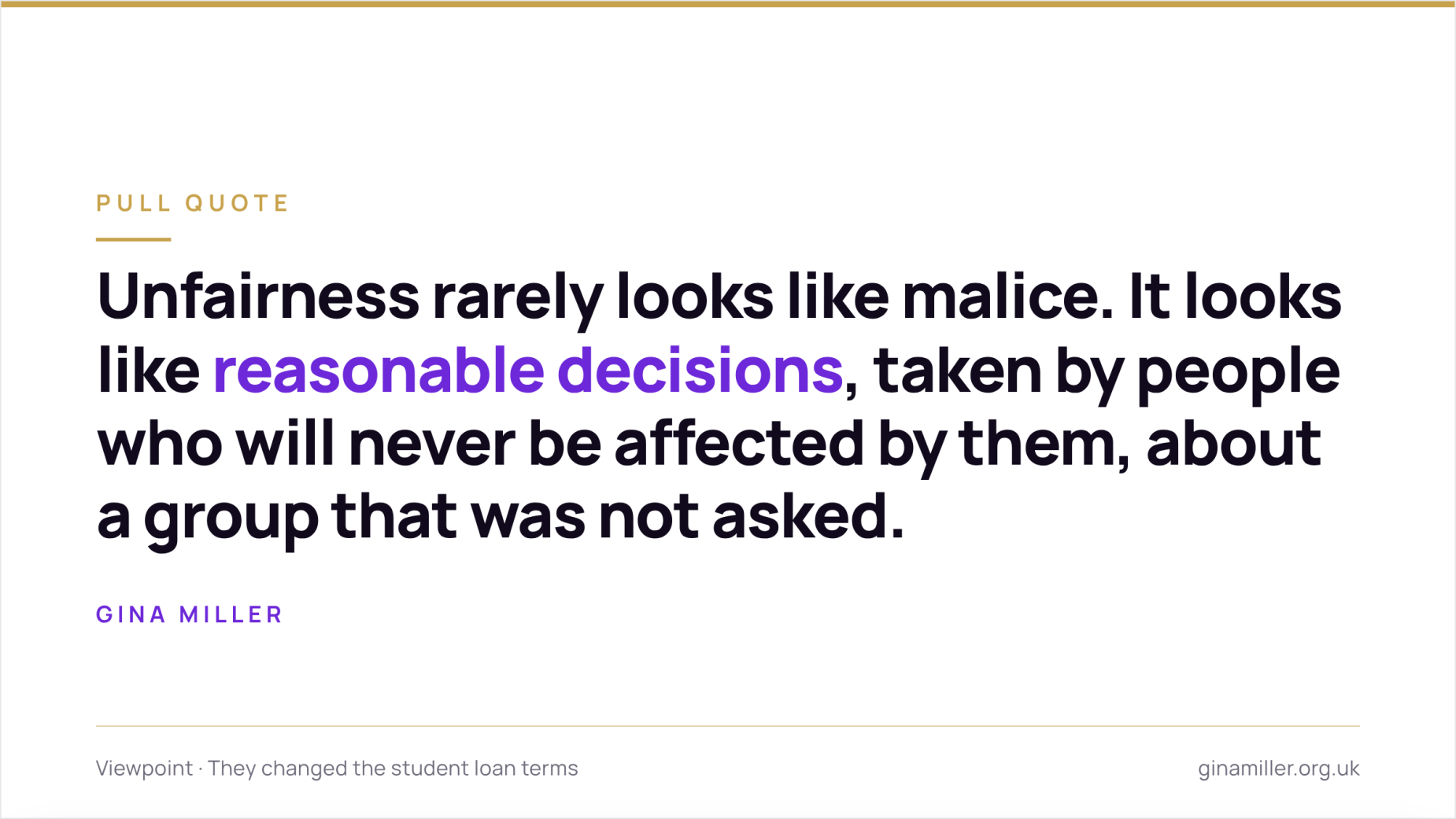
That is what unfairness looks like in practice. Not malice. Just a run of reasonable-sounding decisions, taken by people who will never be affected by them, about a group that was not asked.
Unfairness rarely looks like malice. It looks like reasonable decisions, taken by people who will never be affected by them, about a group that was not asked.
What a fair settlement looks like
So, solutions. Some are the Treasury Committee’s, and some are from my own paper. I have put them in order of how much they would do, not how easy they would be.
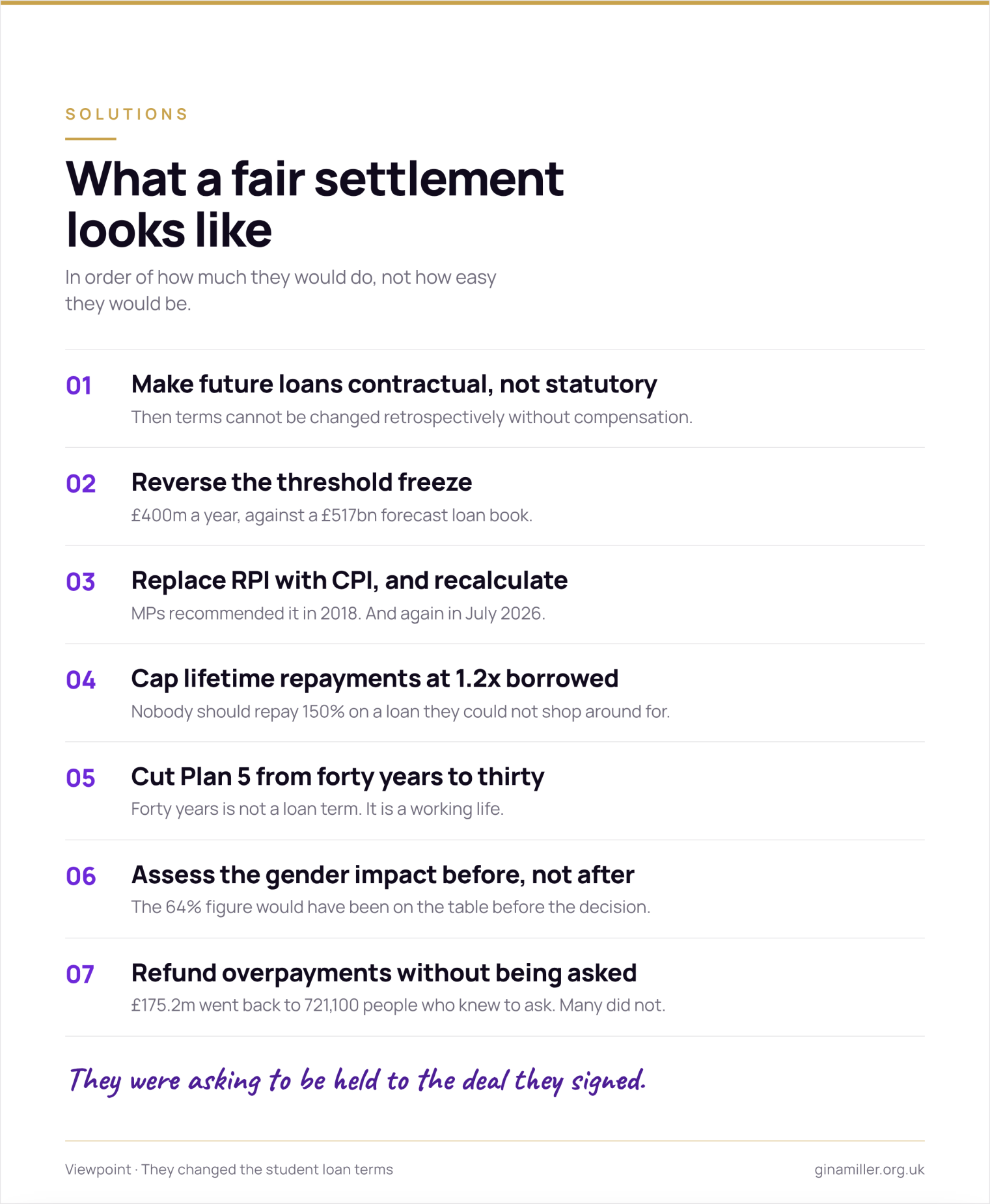
- Make future student loans contractual, not statutory. This was the Committee’s most important recommendation, and it got the least attention. If terms are contractual rather than set by statutory instrument, they cannot be changed retrospectively without compensation. Every other reform on this list is a patch. This one closes the hole.
- Reverse the threshold freeze. The Committee said the government had a moral obligation to do it. The government declined, but the argument remains. It costs around £400 million a year - a rounding error against a £517 billion forecast loan book.
- Replace RPI with CPI, and recalculate past balances. MPs recommended this in 2018, and again in July 2026. RPI usually runs half a point to a point above CPI, and it is being retired from official statistics at the end of the decade anyway. Using a discredited index to charge interest to people who cannot refinance or walk away is indefensible.
- Cap lifetime repayments at 1.2 times the amount borrowed, in real terms. Nobody should repay 150% of what they borrowed on a loan they could not shop around for. A cap would turn an open-ended liability into one you can actually plan around.
- Cut the Plan 5 repayment period from 40 to 30 years. 40 years is not a loan term; it is a working life. 30 years was the Plan 2 term, and it was defensible. 40 was chosen to improve a forecast, not to improve the deal.
- Assess the gender impact before the change, not after. Any change to repayment terms should carry a published gender impact assessment before it is laid, not after. Had one existed in 2022, the 64% figure would have been on the table before the decision - not four years later. Add a 12-month repayment exemption on return from a caring break, so interest does not build up in the exact period when earnings and pension contributions have stopped.
- Refund overpayments without being asked. In 2024-25 the Student Loans Company refunded £175.2 million to 721,100 people who had repaid when they should not have. That averages £240 each. The money was taken correctly under the rules, and returned only to those who knew to ask. Refunds should be automatic.
Why this is a fairness question, not an education one
I know how this argument is usually dismissed. Graduates earn more, so should contribute more. Most people never went to university, and are being asked to subsidise those who did.
All of that is true. None of it is the point.
The point is that a contract was offered and accepted, then altered three times in one direction by the party that wrote it. The people on the other side could not refinance. They could not exit. They had no regulator to appeal to.
I have long called that mis-selling, and the Treasury Committee now agrees. If a financial institution had done the same thing, the redress scheme would already be running.
And it does not fall hardest on the lawyers and the bankers. It falls on nurses, teachers, and social workers. Disproportionately, it falls on women - who will carry it into retirement, deepening the gender pension gap.
Seventeen years ago I started campaigning about hidden charges in the investment industry. The principle was simple: people are entitled to know what they are paying, and to have the terms honoured. I have never understood why that principle should count for less when the other party is the state.
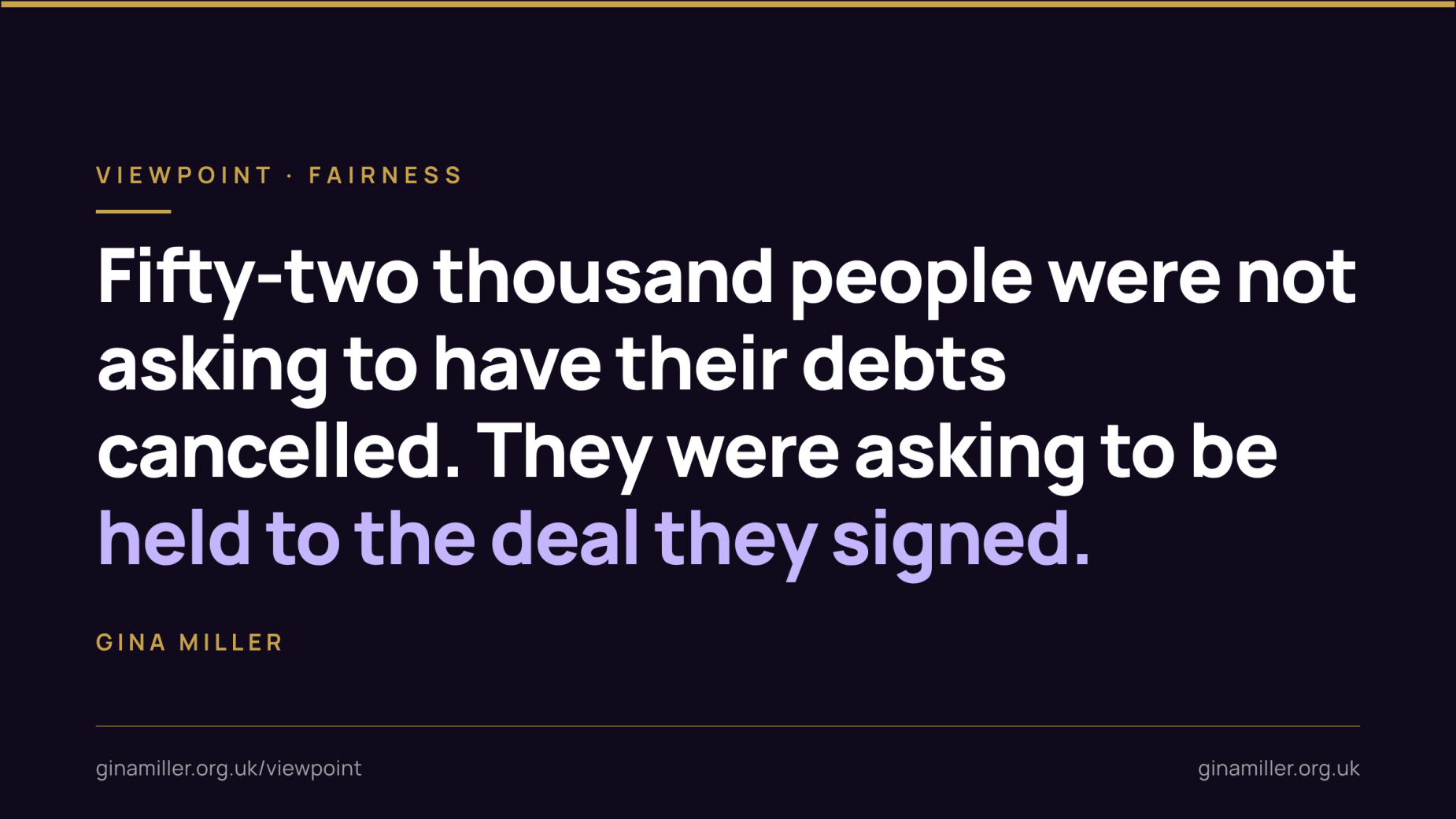
52,000 people answered the call for evidence, and they were not asking to have their debts cancelled. They were asking to be held to the deal they signed.
Declared interest: Gina Miller is the founder of MoneyShe and co-founder of SCM Direct. She submitted written evidence to the Treasury Committee’s inquiry into student loans in April 2026, and published the white paper Breaking the Graduate Trap in March 2026.