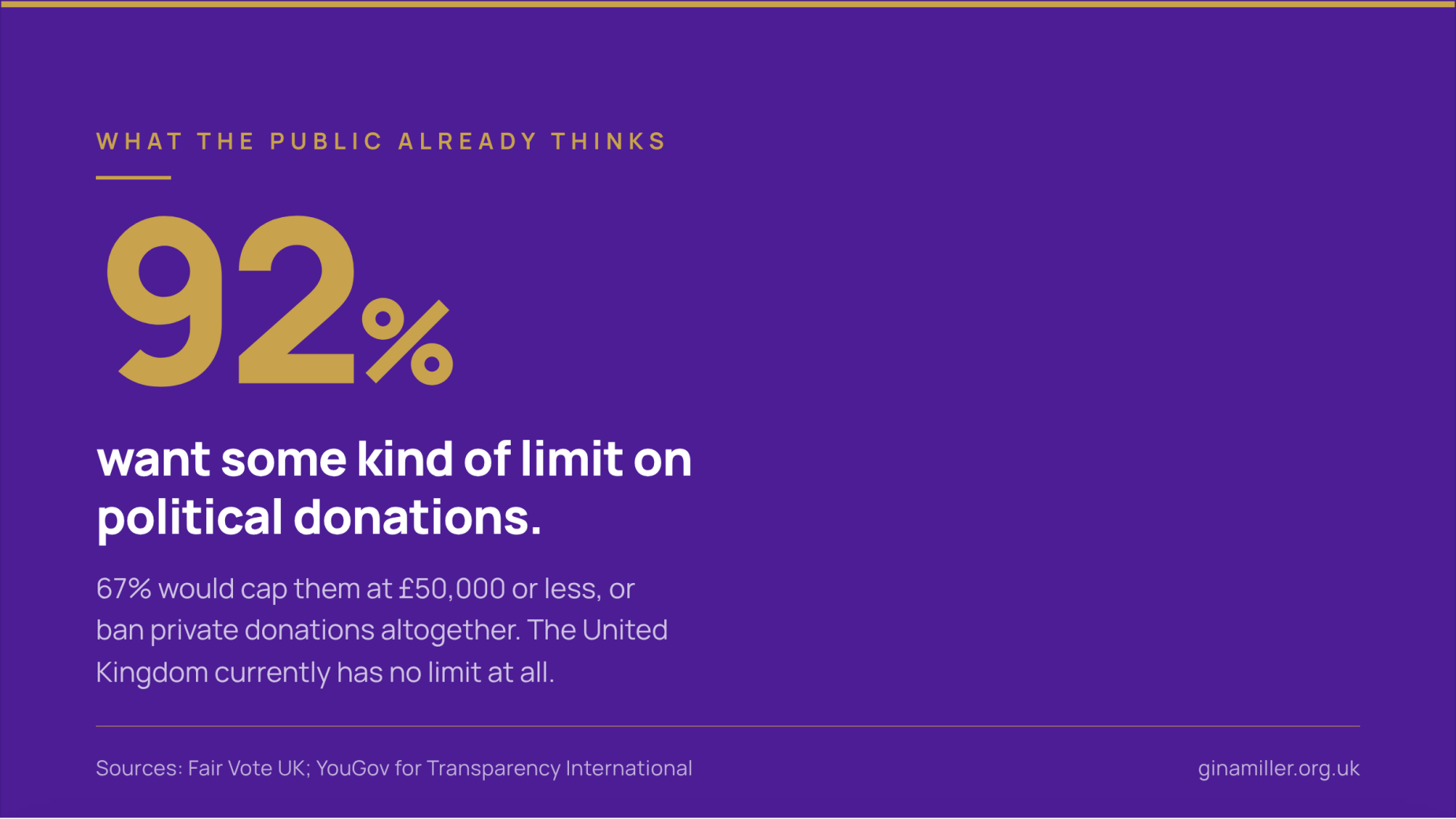
92%
want some kind of limit on political donations
Democracy
October 2026 · 8 Min Read
Who has the standing to say no?
Britain has no written constitution to protect us. It has habits. Here is what happens when those habits stop holding, and the six repairs that would outlast any government and strengthen our democracy.
The essay
Three things happened in Westminster this autumn that the press rightly reported as three separate stories.
In September, the Commons passed the biggest elections Bill in a generation. That same month, two donors gave Reform UK £72 million in two days. They were the largest political donations in British history. And at their party conference, Nigel Farage set out what he would do if Parliament and the courts got in his way:
- sit the Commons around the clock,
- appoint enough peers to take control of the Lords,
- put the make-up of the second chamber to a referendum,
- and look again at how judges are chosen.
I am not going to spend this essay on any one politician. I have been accused often enough of fighting yesterday's battles against particular men, but the accusations always miss what actually worries me.
Those three stories are not linked by a party. They are linked by a question, and it applies to every government, including ones I would vote for. When someone decides not to be restrained, what actually stops them?
The honest answer is: in our system, less than most people assume.
The constitution is a set of habits
Britain has no single document you can hold up. Instead, we have a pile of laws, court rulings, precedents, and conventions. One simple expectation holds a surprising amount of it together: that people in high office will behave well.
Historians have a name for this. The civil servant Clive Priestley coined the "good chap theory of government" in 1985. Peter Hennessy made it famous. He defined it as knowing the unwritten rules and wanting to follow them.
In 2019, Hennessy and Andrew Blick revived the idea for the Constitution Society. They were careful. They did not say the constitution was about to collapse. Instead, they warned of a "gradual fraying by stages".
That democracies in trouble are rarely knocked down overnight. They get quietly renovated, over years. A reasonable exception is made. The exception becomes routine. The routine becomes the rule. And at no point is there a single moment that looks like the moment to object.
"The British constitution runs on good chaps doing the right thing. When the chaps stop being good, you discover how few guardrails we actually have."
What an emergency actually is
Start with the loudest of the three stories - the promise of a national emergency. It is the one where the law is clearest and least understood.
In British law, an emergency is not a mood or a mandate. It is a gateway, and the Civil Contingencies Act 2004 controls who may walk through it. Section 19 sets a narrow definition. An emergency means:
- serious damage to human welfare,
- or serious damage to the environment,
- or war or terrorism that threatens the security of the United Kingdom.
Section 21 then adds three conditions: - the emergency must be happening or about to happen.
- The action must be necessary.
- And the need must be urgent.
Ministers cannot reach for these powers if existing law could do the job without serious delay.
What the gateway opens is substantial. Emergency regulations can seize property, ban movement and gatherings, create criminal offences, rewrite Acts of Parliament, and deploy the armed forces.
But the Act fences the power in. The regulations die after 30 days. They die within seven days unless both Houses vote to keep them. Any new offence is minor, with a maximum sentence of three months. And ministers cannot use these powers to touch the Human Rights Act.
So anyone promising a national emergency faces a simple choice. Either what they have in mind meets the legal test – in which case the judges they distrust are the very people who would confirm it. Or it does not, and they owe us a plain answer about what power they think they are using instead.
Here is what should genuinely worry us, and it has nothing to do with any manifesto.
These emergency powers have never been used. Not once.
In 2020, during Covid, the government faced the closest thing to a national emergency in living memory. It did not use the Act that Parliament built for exactly that moment. Instead, it legislated under the Public Health Act 1984 and the Coronavirus Act 2020. In doing so, it bypassed every safeguard I just listed. Over 500 coronavirus regulations were laid in 18 months. 91 used emergency procedure.
The guardrails were not broken. They were simply not the route anyone took.
The erosion nobody reports
Which brings me to the quietest part of this, and the most important. It is also the reason I empty rooms at parties.
Parliament passes around a thousand statutory instruments a year. These are real laws. They create offences, set charges and change what people are entitled to. Roughly three-quarters of them become law unless somebody objects.
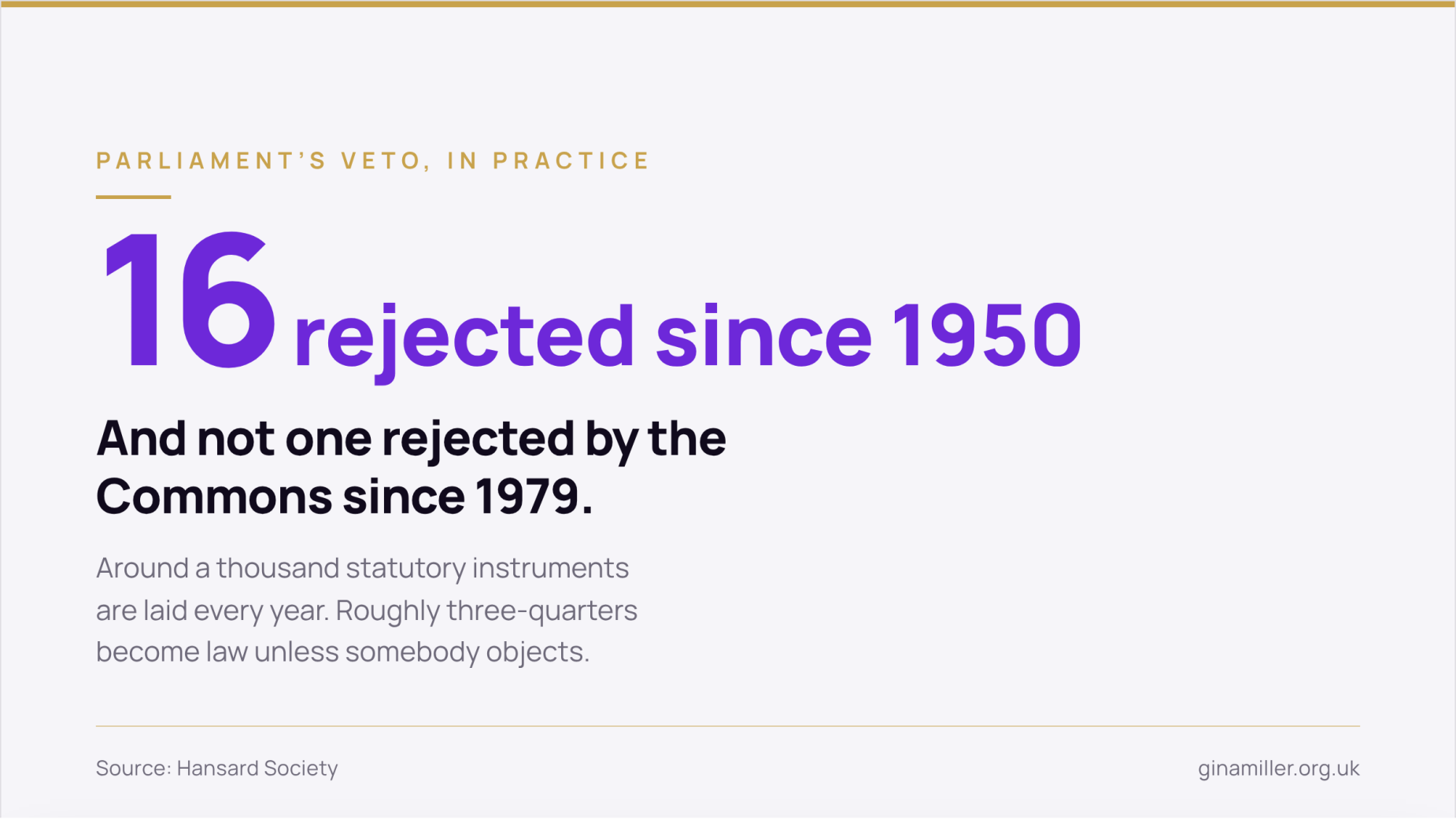
Under a government with a majority, objecting is close to theoretical. The Hansard Society counts just 16 instruments rejected since 1950. The Commons has not rejected a single one since 1979.
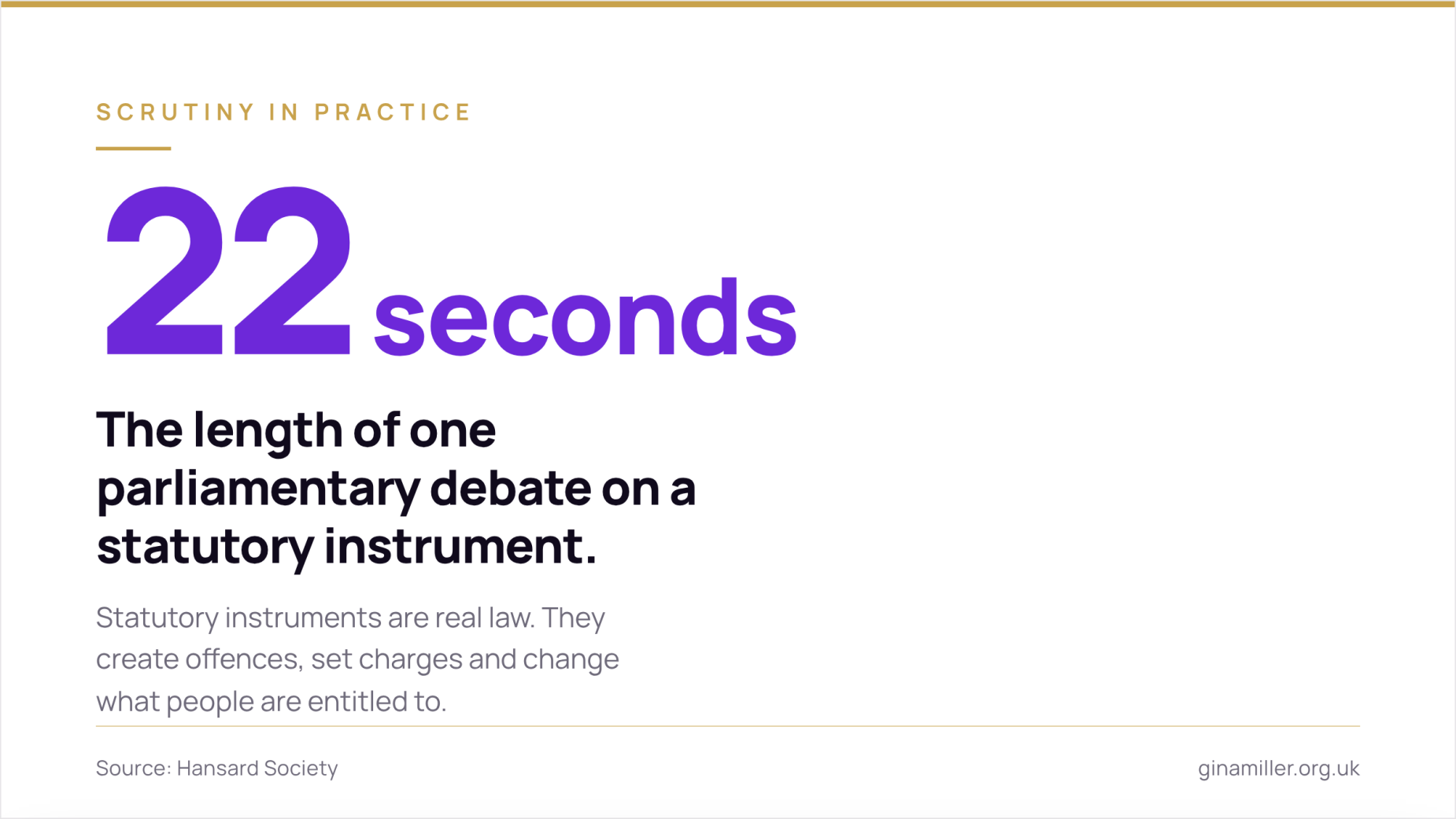
And when they are looked at, the looking is brief. The Hansard Society found one debate that lasted twenty-two seconds. A 619-page product safety instrument got fifty-two minutes. Nearly one in ten instruments in the 2021-22 session had to be corrected afterwards by another instrument.
On top of this, two more devices sit. Henry VIII clauses let a minister rewrite an Act of Parliament by order. Skeleton bills pass a bare framework and leave the real content to be filled in later. In November 2025, the House of Lords Constitution Committee put skeleton bills at the "extreme end of the spectrum of legislative uncertainty" and said government should avoid them.
This is not a complaint about paperwork. It is where power has actually moved. A government that wanted to govern without Parliament would not need to declare anything at all. The machinery is already there. It is already normal. And almost nobody is watching it.
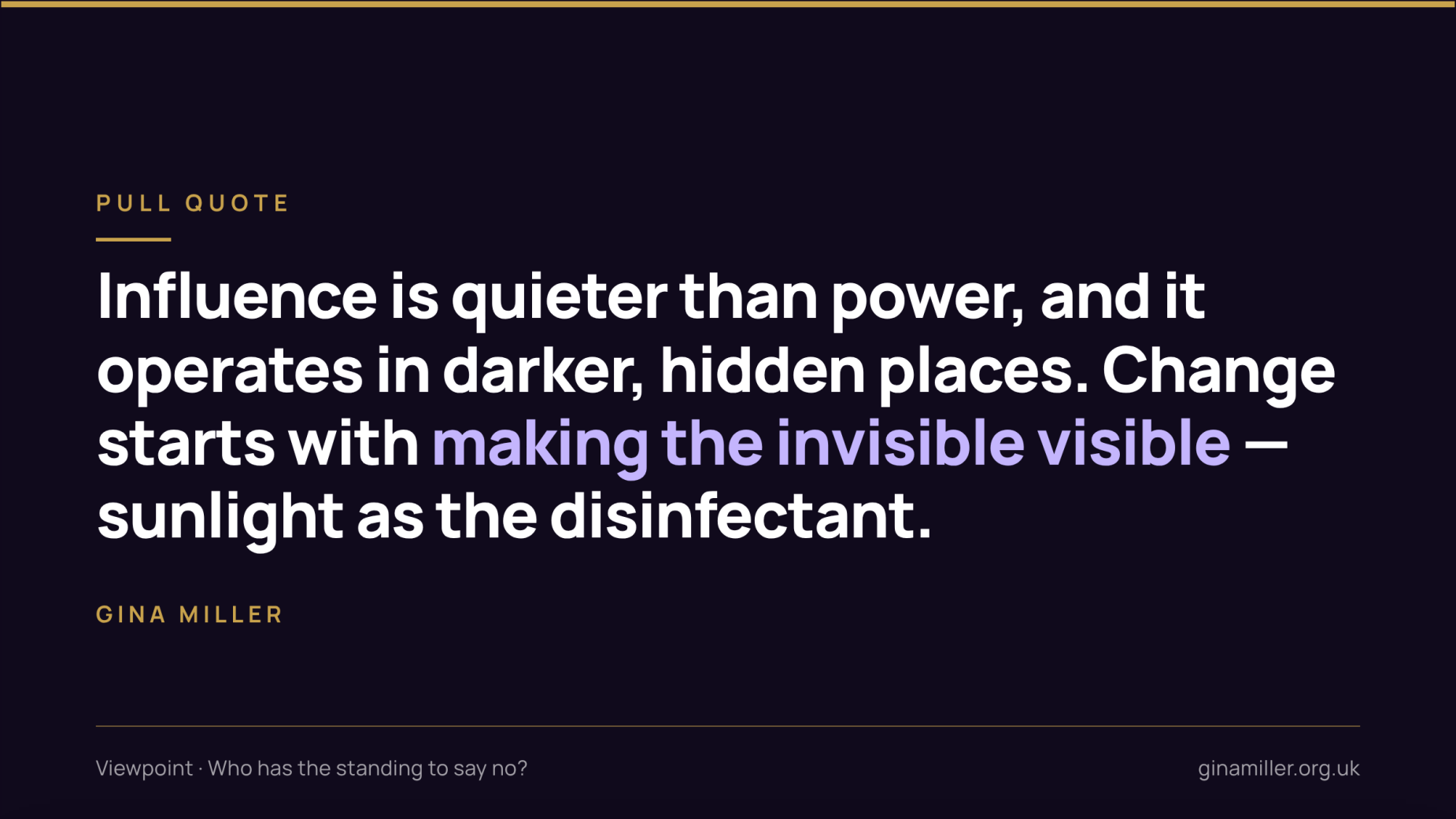
"Influence is quieter than power, and it operates in darker, hidden places. Change starts with making the invisible visible – sunlight as the disinfectant."
Money, and the door the rest of us cannot find
The second story was the money. I want to be careful here, because my point is structural, not personal.
Ten years ago, donations of a million pounds or more made up about one penny in every pound given to British political parties. By 2024, they were 35%. In 2023, 19 people between them gave two-thirds of all private donations. These are Transparency International UK's figures, and they cover every party, not just one.
I have spent more than 30+ years in financial services. I cannot take a single pound from a client without proving where it came from. A political party can take millions without that kind of scrutiny. Somebody needs to explain why the rules are tougher on your pension than on your politics.
And a cap is only worth having if it binds everyone. This party's donors. That party's unions. Whoever comes next. Political money reform that seems to target a rival's backers isn't reform. It is opportunism with better manners.
The watchdogs that can be abolished on a whim
A third layer exists, and it is the most fragile of the lot.
The UCL Constitution Unit tried to count Britain's constitutional watchdogs and concluded that no definitive list exists. It found 19 bodies across seven categories. It notes that their powers result from historical accidents rather than design.
Several of the most important have no legal basis: the Commissioner for Public Appointments, the Independent Adviser on Ministerial Standards, and the House of Lords Appointments Commission. The Unit's verdict is blunt. They are "vulnerable to abolition or significant weakening at a Prime Minister's discretion".
The Institute for Government makes the same point about the Ministerial Code. The Prime Minister decides what it means and decides what happens when it is broken. As they put it, the rules are only as good as the people enforcing them.
A code with no penalty is not a rule. It is a suggestion. And rules that bind only the honourable bind nobody.
What the public already understands
Politicians often say people do not care about any of this. The evidence says the opposite.
The Constitution Unit surveyed more than 6,000 people. Three-quarters agreed that a healthy democracy requires politicians to always act within the rules. Only 6% preferred getting things done even if rules get broken. Around four in five want a system that can actually punish politicians who lack integrity.
Support for the idea that judges play an important role in holding politicians to the rules is also climbing. It was 32% in 2021. By 2022 it was 41% - a nine-point jump in a single year.
Then there is the figure that frightened everyone who read it. In the Hansard Society’s 2018 audit, 54% agreed Britain needed a strong leader willing to break the rules. By 2022, that had fallen to 29%.
People are not asking for less democracy. They are asking for one that works.
Six repairs
So, solutions - because an essay that only diagnoses is just a complaint with footnotes. I have chosen these deliberately. I would accept being governed under every one of them, whoever is in power.
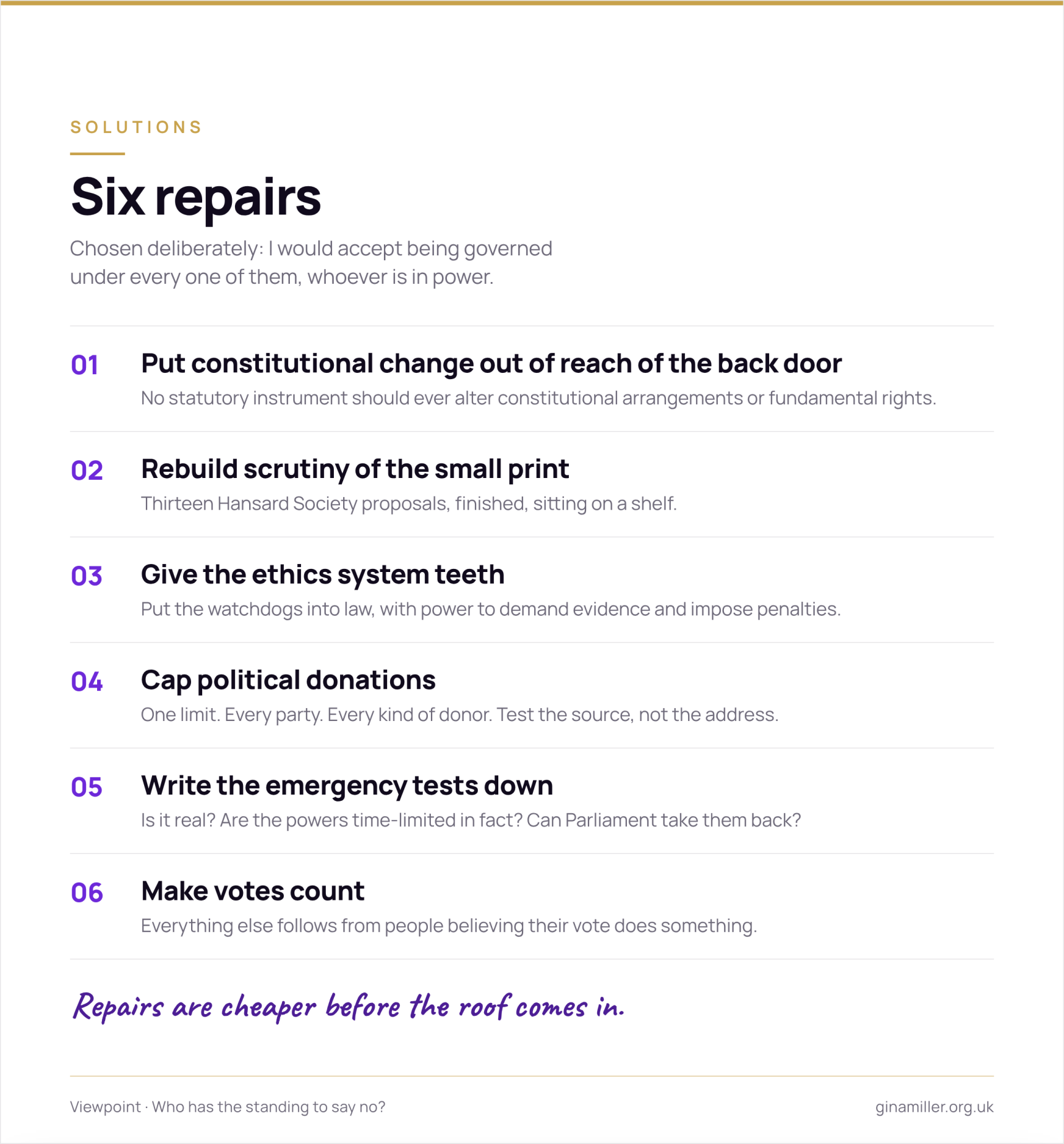
- Put constitutional change out of reach of the back door. No statutory instrument should ever be able to change our constitutional arrangements or our fundamental rights. Not under a government I oppose. Not under one I support. This is one line in one Act, and it is the most valuable reform on this list.
- Rebuild scrutiny of the small print. The Hansard Society has already done the work. An agreement on what may never be delegated. One scrutiny procedure instead of nine. A sifting committee. And a narrow urgent route for genuine emergencies that expires automatically. Thirteen proposals, finished, sitting on a shelf.
- Give the ethics system teeth. Put the Ministerial Code, the Independent Adviser and the appointments watchdogs into law, with the power to demand evidence, publish what they find and impose penalties. Thirty-five people across the Institute for Government, the Constitution Unit and the UK Governance Project proposed exactly this in 2024.
Beyond that, Patrick Dunleavy's case for an Independent Commission Against Corruption, on the Australian model, is the most serious proposal in circulation. It would have its own investigators and the power to call ministers to account. Pair it with putting the Nolan Principles into law rather than leaving them as good intentions. - Cap political donations. One limit. Every party. Every kind of donor. Write it into primary legislation, and test where the money actually came from rather than the address on the cheque. Two-thirds of the public have already told us where they would set it.
- Write the emergency tests down. Three questions, for any government. Is the emergency real, or just urgent-sounding? Are the powers genuinely time-limited, not just on paper? Can Parliament take them away again, rather than rubber-stamp them? France's Constitutional Council reviews emergency powers automatically after sixty days. Germany’s Basic Law allows no shift of power to the executive. We rely on restraint, and hope.
- Make votes count. Everything else follows from people believing their vote does something. An amendment signed by more than 150 MPs deserved to be heard, not ruled out of scope.
A note on doing this
One last thing, and it is the most personal part of this essay.
I went to court twice to ask whether a government was acting within the law. Twice, the Supreme Court said the question was legally sound and fair.
What came back was not an argument. It was years of abuse and threats. And the point of that was never really to change my mind; it was to make the next person think twice before asking.
In a healthy democracy, you answer the argument. In an unhealthy one, you go after the person making it. The test of which kind we are living in is not how power behaves when it is comfortable. It is how it behaves when it is questioned.
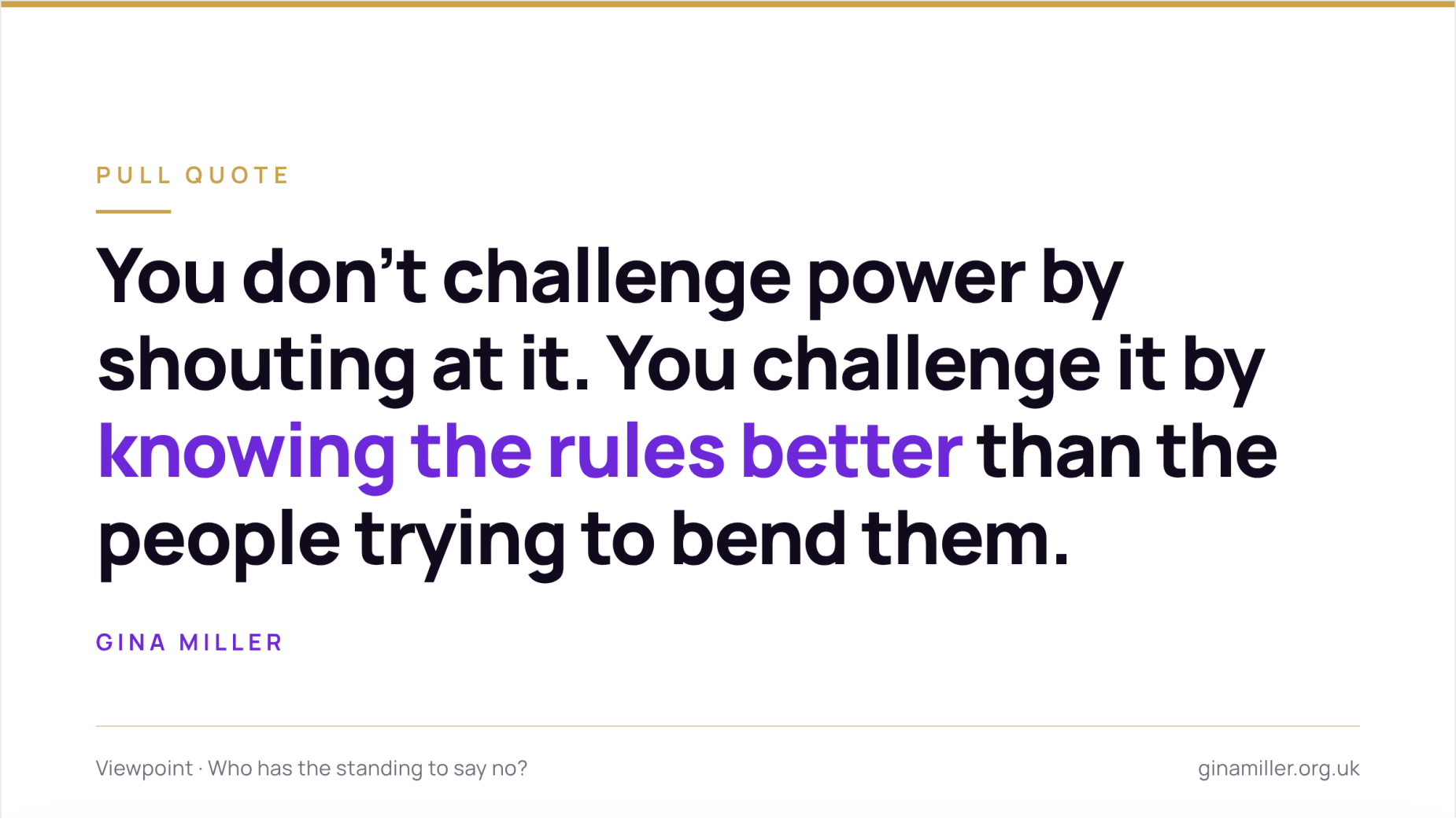
"You don't challenge power by shouting at it. You challenge it by knowing the rules better than the people trying to bend them."
That work is slow, unglamorous and almost entirely invisible. It is also exhausting. So I will say to anyone thinking of doing it what nobody said to me. Look after your strongest weapon: you. Pace yourself. And do it with other people, because you cannot hold a line on your own.
Britain is not on the brink. I have never said it was, and I am not saying it now.
But roofs don't fall all at once. They leak quietly for years, while everyone agrees it isn't worth putting up the scaffolding yet.
Here is what I have learned, at a cost I would not choose again. People who bend rules aren't counting on your fear. They are counting on something far more ordinary. They are counting on you being tired. On you having a job, children, a life, and better things to do on a Tuesday night than read a statutory instrument.
Mostly, they are right.
But those of us who can need to carry on highlighting that the guardrails need fixing now, while you still like the people holding the keys. That is the whole argument. Wait until you don't, and you are asking the person who benefits from the gap to close it.
Ask the question. Ask it of the government you voted for, in exactly the voice you would use for one you didn't. Who signed this? What did it change? Who was allowed to object?
They will tell you it is procedural. It is not procedural. It is the difference between a country where power has to explain itself and one where it does not.
Parliament must not be bypassed. The rule of law must hold.
And vigilance is not a mood you are in. It is something you do - on an ordinary Tuesday, when nobody is watching, and nothing has happened yet.
Whoever is in power.